The hidden collapse of shared organizational reality
Every employee carries a mental model of how the organization actually works.
Who really makes decisions? Who influences priorities? Where do projects get blocked? Who owns what? How does information flow?
These mental models are rarely identical.
As organizations grow, reorganize, merge, or simply evolve, these perceptions can gradually diverge.
Eventually, people stop navigating the same organization — even though they all work for the same company.
The result is an invisible fragmentation of organizational reality.
What is an Organizational Map?
An Organizational Map is not an organizational chart.
An organizational chart describes the formal structure: reporting lines, positions and responsibilities.
An Organizational Map represents something different: how people perceive and navigate the organization when alignment begins to deteriorate.
The Maps make visible the patterns that emerge when formal structure and lived organizational reality begin to diverge.
Together, the twelve Maps describe a progression from early structural divergence to advanced organizational fragmentation.
A three-stage model of organizational fragmentation
The framework groups the twelve Maps into three stages. The stages are not simply levels of organizational dysfunction. They represent increasing divergence between the organization's formal structure and the way people actually navigate decisions, influence, accountability and execution.
1. Early Fragmentation
The organization is still structurally recognizable, but people are beginning to navigate it differently.
At this stage, the formal organization remains largely intact. However, authority, information flows, priorities and relationships are beginning to diverge from the intended structure.
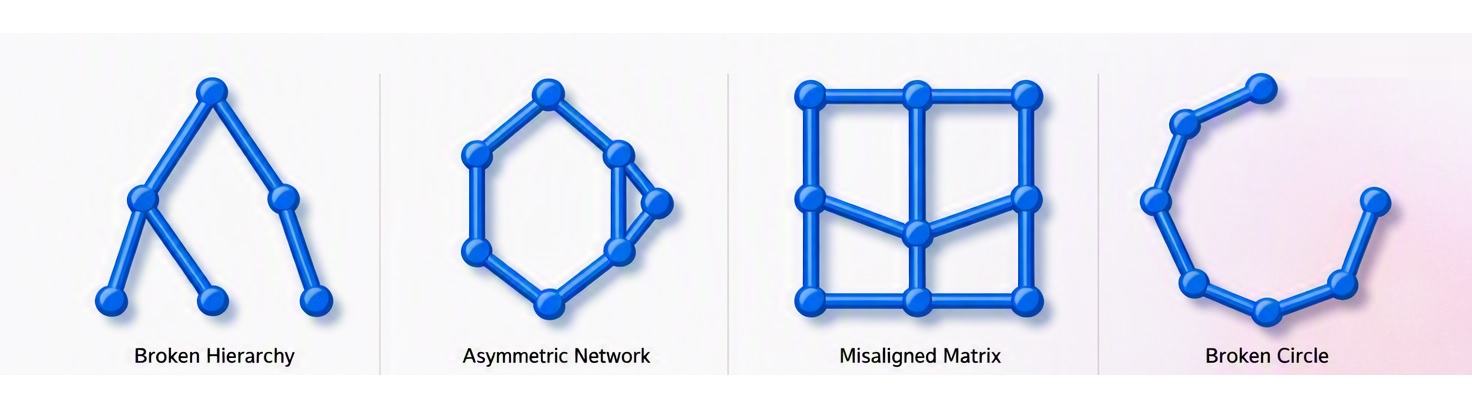
The four early-stage maps:
- Broken Hierarchy — formal authority remains visible, but practical decision-making begins to diverge from it.
- Asymmetric Network — collaboration and influence become unevenly distributed across the organization.
- Misaligned Matrix — multiple dimensions of authority exist, but their priorities and decision rights no longer align.
- Broken Circle — a structure based on shared coordination develops gaps in information, influence or accountability.
Leadership signal: the organization still appears coherent from the outside, but different parts are beginning to operate from different assumptions.
2. Mid-Stage Fragmentation
The organization still appears connected, but the connections no longer produce consistent coordination.
Fragmentation has become more embedded. Formal structures continue to exist, but increasingly rely on workarounds, informal influence and escalation to function.
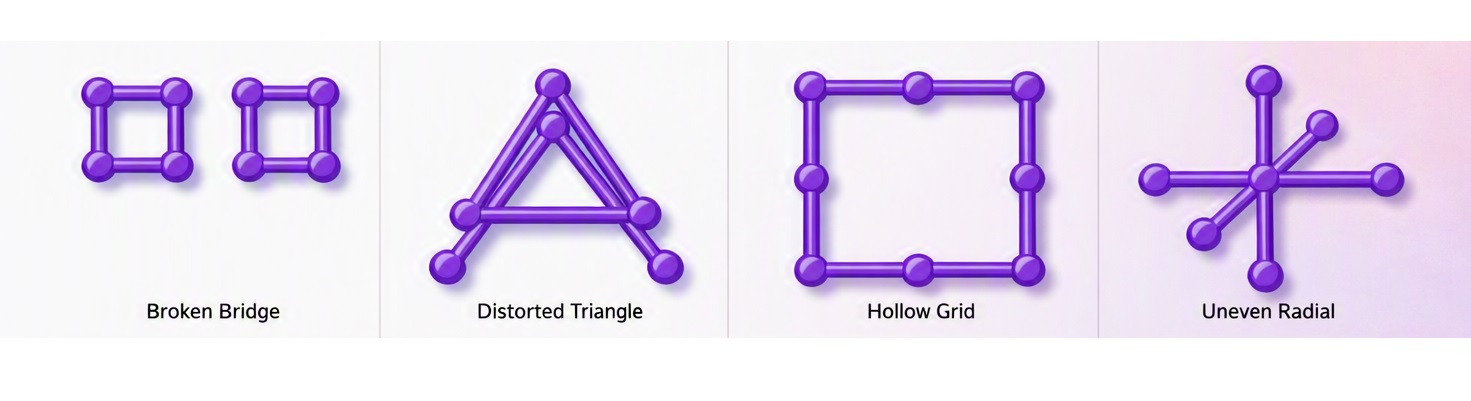
The four mid-stage maps:
- Broken Bridge — critical connections between organizational groups weaken, separating functions, leadership layers or business units.
- Distorted Triangle — critical organizational forces that should remain balanced begin pulling in different directions.
- Hollow Grid — the organization retains an apparent network of structures and processes, but the connections no longer provide effective coordination.
- Uneven Radial — influence and decision-making concentrate around selected nodes while other parts become peripheral.
Leadership signal: cross-functional friction, duplicated effort, competing priorities and growing dependence on informal networks become increasingly visible.
3. Advanced Fragmentation
The organization remains formally intact but is increasingly experienced as multiple organizations.
At this stage, shared organizational reality has weakened significantly. Different groups increasingly navigate separate priorities, relationships and decision structures.
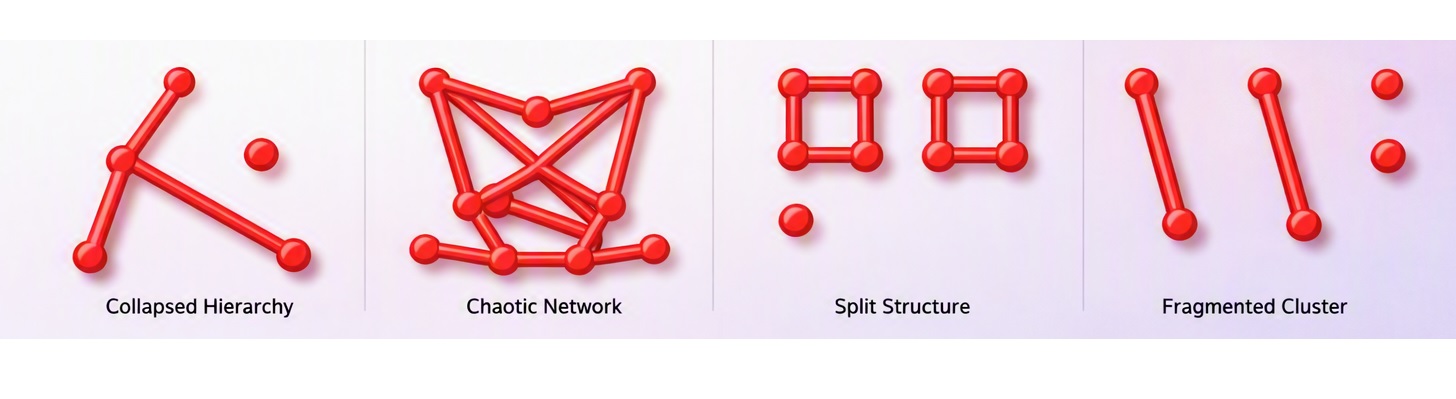
The four advanced-stage maps:
- Collapsed Hierarchy — formal hierarchy loses practical authority as decisions migrate into informal channels.
- Chaotic Network — relationships and information flows become increasingly unpredictable, without a stable coordination structure.
- Split Structure — significant parts of the organization operate according to fundamentally different priorities or operating logics.
- Fragmented Cluster — the organization effectively breaks into multiple self-contained clusters with weakening shared governance, accountability and priorities.
Leadership signal: governance becomes reactive, accountability becomes ambiguous, decisions slow, and execution increasingly depends on individual intervention.
Why organizational fragmentation matters
When teams operate from different Organizational Maps, fragmentation rarely announces itself as a structural problem.
Instead, it appears through symptoms that leadership teams often interpret separately:
- Strategy becomes open to interpretation.
- Priorities begin to compete.
- Decision-making slows.
- Ownership becomes blurred.
- Accountability weakens.
- Governance becomes increasingly reactive.
- Execution becomes inconsistent.
- Trust gradually erodes.
These symptoms are often treated as communication problems, process problems or change-management challenges.
They may instead be manifestations of a deeper structural perception problem.
The leadership blind spot
One of the most common mistakes leaders make is assuming that the organization they designed is the organization people experience.
Leaders see the intended operating model. Teams navigate the lived operating model.
The gap between the two can explain why initiatives stall, transformation programmes lose momentum, governance becomes reactive and execution deteriorates even when the underlying strategy remains sound.
A better question
Instead of asking:
"Do we have the right organizational structure?"
Leadership should ask:
"Which organizational map are our teams actually navigating?"
Because the structure documented in a strategy presentation or organizational chart is rarely the complete structure people use to make decisions every day.
From Organizational Maps to Rapid Clarity™
The 12 Organizational Maps™ provide the structural lens. Rapid Clarity™ turns that lens into a senior-level diagnostic intervention.
The objective is not simply to identify a Map. It is to understand where fragmentation is affecting decisions, governance and execution — and what needs to be reset.
- Identify the organization's current structural reality.
- Diagnose fragmentation and governance disconnects.
- Reveal the perception gaps affecting decisions and execution.
- Restore a shared operating reality.
- Translate clarity into practical operating and execution priorities.
From clarity to execution
Diagnosis is not the end point.
Once the structural reality is understood, leadership can determine what needs to change — whether through organizational stabilisation, an operating model reset, restructuring or a broader transformation programme.
The resulting priorities can then be translated into an Operating Model and reinforced through Execution Systems .
Designed for executive leadership
The framework is particularly relevant when organizational complexity has reached a point where conventional structural descriptions no longer explain what is happening in practice.
- CEOs navigating organizational complexity or transformation
- COOs responsible for execution and operating-model effectiveness
- CFOs facing structural, governance or accountability challenges
- Executive teams experiencing strategic drift or decision friction
- Boards seeking an independent view of organizational reality
- Organizations undergoing restructuring, scaling or transformation
A framework for organizational coherence
The 12 Organizational Maps™ form part of a broader approach to understanding Organizational Reality Architecture: the difference between how an organization is designed to work and how it is actually experienced and navigated.
The purpose is not to add another layer of organizational complexity.
It is to make the hidden structure visible, identify where coherence has been lost, and provide leadership with a more precise basis for restoring alignment and execution discipline.