Chapter 1: The Macroeconomic Mirage
The artificial intelligence build-out is historically unprecedented in its capital intensity. Over the past several years, the technology ecosystem, supported by major cloud providers, specialized infrastructure funds and private credit, has committed hundreds of millions of dollars to physical expansion: next-generation data centers, specialized semiconductors and high-density power supply.
A macroeconomic paradox has emerged. While the physical capacity to compute keeps expanding, the unit cost of inference is falling steeply.
- The deflationary trap: efficiency gains mean that the same computational task costs a fraction of what it did twelve months ago. Infrastructure operators need very large volume growth merely to service fixed debt and capital expenditure.
- The private credit exposure: unlike past technology cycles funded mostly by public equity, a significant part of this build-out relies on private credit, specialized leasing vehicles and project finance debt, which are far less transparent.
When financing conditions tighten, or when policy in Washington shifts on energy subsidies, export controls or antitrust enforcement, the vulnerability of this financing structure becomes apparent. If enterprise demand fails to keep pace with physical capacity, the resulting oversupply will trigger write-downs that reach well beyond the technology sector, into institutional portfolios and credit markets.
Chapter 2: The Enterprise Value Gap in Financial Services
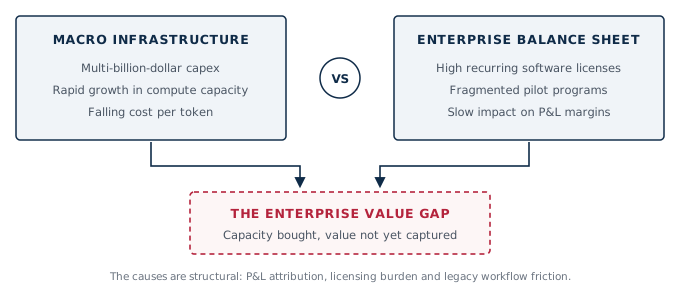
For banks, asset managers, wealth managers and insurers, the macroeconomic oversupply of compute turns into a specific internal dilemma: the enterprise value gap.
Figure 1: Capacity is bought on the macro side; value has to be captured on the balance sheet.
Innovation teams have launched many proof-of-concept projects, yet turning these tools into durable balance-sheet value remains elusive. The reasons are structural rather than technological:
- The P&L attribution problem: most AI tools in financial services are deployed as horizontal productivity aids: summarizing documents, drafting client correspondence, writing code. Convenient as they are, these micro-efficiencies rarely translate into lower costs, lower operational risk or measurable revenue growth.
- The software licensing burden: institutions are locked into escalating multi-year enterprise software agreements, paying high recurring fees for underlying models whose raw capabilities are commoditizing fast.
- Legacy workflow friction: layering language models on top of fragmented core banking platforms and siloed data warehouses creates operational drag rather than automation.
Field Example: What a build costs now
A content management and publishing platform serving a community organization, complete with event management across multiple locations, editorial governance, community-management workflows, SSO for external and internal users, and public information displays, was initially estimated at 180–210 person-days of traditional software development. Using AI-assisted development, the project was completed in fewer than five working days, reducing delivery effort to roughly one-fortieth of the conventional estimate.
The lesson is not that software has become free. Specification, testing, security and ownership still take judgment, and the decisions about what to build did not get any easier. But the cost of building has collapsed, while many institutions still sign multi-year license agreements priced for the old cost. That is the licensing burden above, and it leads directly to the fourth and fifth traps below.
Chapter 3: The Four Structural Traps of AI Deployment
When institutional AI initiatives stall or fail to generate returns, five failure modes recur. They are not technical bugs; they are flaws in how financial firms govern technology.
- Trap 1, capital allocation without gatekeeping: AI budgets are treated as open-ended R&D pools rather than disciplined capital investments. Projects are funded for their novelty, not against hurdle rates tied to P&L realization or risk reduction.
- Trap 2, fragmented accountability: decision rights between the CIO, the CRO, business heads and compliance are ambiguous. When ownership is spread across departments, accountability evaporates, pilots are duplicated and deployments stall.
- Trap 3, operating model bloat: AI orchestration layers and governance committees are added on top of already heavy structures. Instead of streamlining operations, the institution creates a new layer of administration.
- Trap 4, vendor lock-in and horizon blindness: vendor commitments are not stress-tested against three-year depreciation cycles, falling token costs and the falling cost of building software in-house. Long-term capital goes into proprietary stacks that may become obsolete or uneconomic as open alternatives mature.
- Trap 5, the subscription price trap: today's AI subscriptions are priced to win adoption, not necessarily to cover their full cost. Once processes, staff and data run on one provider, switching becomes expensive, and prices can rise with little resistance. Institutions are exposed twice: today, they pay to reorganize around a technology whose benefits are not yet within reach; tomorrow, when the benefits finally materialize, the subscription price can rise to capture them.
Chapter 4: The Decision Architecture Framework
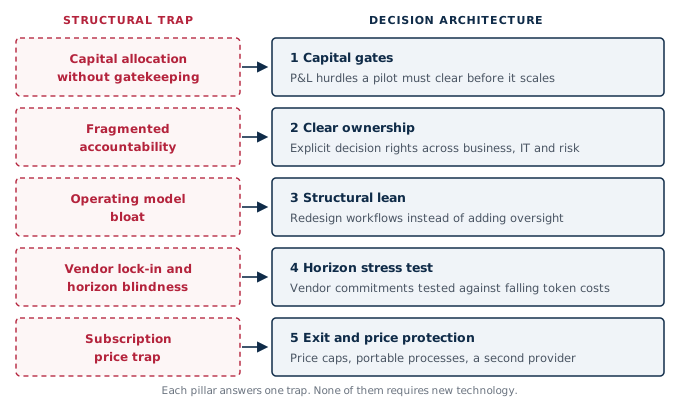
To close the value gap and navigate current market volatility, leadership has to move from acquiring capacity to structural discipline. Each of the five traps has its answer:
Figure 2: From the five structural traps to the decision architecture framework.
- Enforce capital gates: set financial hurdles that a pilot must clear before it moves from testing to production. If an initiative cannot show a clear path to margin expansion or risk reduction, its funding is reallocated.
- Map clear ownership: define exact decision rights. The business head owns the outcome, the CRO owns the risk parameters, and IT owns the execution infrastructure, with no overlapping grey zones.
- Streamline the operating model: use AI implementation to simplify the organization and remove redundant management layers, rather than digitizing legacy inefficiencies.
- Stress-test long-term commitments: test every enterprise software agreement against falling technology costs, and keep the contractual flexibility that avoids stranded capital.
- Protect exit and price: negotiate price caps and notice periods for multi-year use; keep data, prompts and workflows portable; design processes so that a second provider or an open model can take over. Budget AI services against a price scenario well above today's.
Conclusion: Assessing Institutional Readiness
To close the value gap and navigate current market volatility, leadership has to move from acquiring capacity to structural discipline. Each of the five traps has its answer:
Figure 2: From the five structural traps to the decision architecture framework.
- Enforce capital gates: set financial hurdles that a pilot must clear before it moves from testing to production. If an initiative cannot show a clear path to margin expansion or risk reduction, its funding is reallocated.
- Map clear ownership: define exact decision rights. The business head owns the outcome, the CRO owns the risk parameters, and IT owns the execution infrastructure, with no overlapping grey zones.
- Streamline the operating model: use AI implementation to simplify the organization and remove redundant management layers, rather than digitizing legacy inefficiencies.
- Stress-test long-term commitments: test every enterprise software agreement against falling technology costs, and keep the contractual flexibility that avoids stranded capital.
- Protect exit and price: negotiate price caps and notice periods for multi-year use; keep data, prompts and workflows portable; design processes so that a second provider or an open model can take over. Budget AI services against a price scenario well above today's.