Strategic Insight
When Accountability Is Clear but Decisions Still Fail
Accountability is not authority. Decision rights are the hidden architecture of execution — and fragmentation destroys them.
Executive Summary
In many organizations, accountability is clear, roles are defined, and responsibilities are documented — yet decisions still stall, escalate unnecessarily, or fragment across teams.
Leaders often interpret this as hesitation, lack of ownership, or weak execution. In reality, the organization may have lost structural clarity about who has the authority to decide, which decisions belong where, what requires validation, and what information must support the decision.
This Insight examines why accountability alone cannot move decisions, why decision rights form a critical layer of organizational architecture, and how structural drift creates decision paralysis even in competent and high-performing teams.
Accountability Is Not Authority
Accountability describes who owns the outcome. Authority describes who has the legitimate power to decide. Decision rights define which specific decisions belong to that authority and within what boundaries.
Governance determines how decisions are validated, challenged, or escalated. Information determines what the decision relies on. Execution determines how the decision is translated into action.
When these elements are aligned, decisions move. When they diverge, decisions stall — even when accountability is perfectly clear. A person can therefore be fully accountable for an outcome without having sufficient authority to determine that outcome.
This distinction is frequently overlooked because organizations tend to document responsibilities more rigorously than they define actual decision rights.
That is why decision-making problems cannot always be solved through communication workshops, leadership coaching, or additional reporting. When the underlying architecture is fragmented, the problem is structural.
Decision Architecture: The Hidden Structure of Execution
Decision architecture is the system through which an organization allocates authority, defines decision rights, establishes governance boundaries, distributes information, and determines escalation pathways.
It answers a deceptively simple set of questions:
- Who has the authority to decide?
- Which decisions belong at which organizational level?
- Which decisions can be taken autonomously?
- Which decisions require validation?
- What information is required before a decision can be made?
- When and how should a decision be escalated?
- Who has the right to challenge or override the decision?
When these boundaries are explicit, organizations can operate with greater autonomy and speed. When they become ambiguous, decisions migrate upward, sideways, or across organizational boundaries.
The result is not simply slower decision-making. It is a progressive loss of organizational coherence.
The Decision Rights Matrix
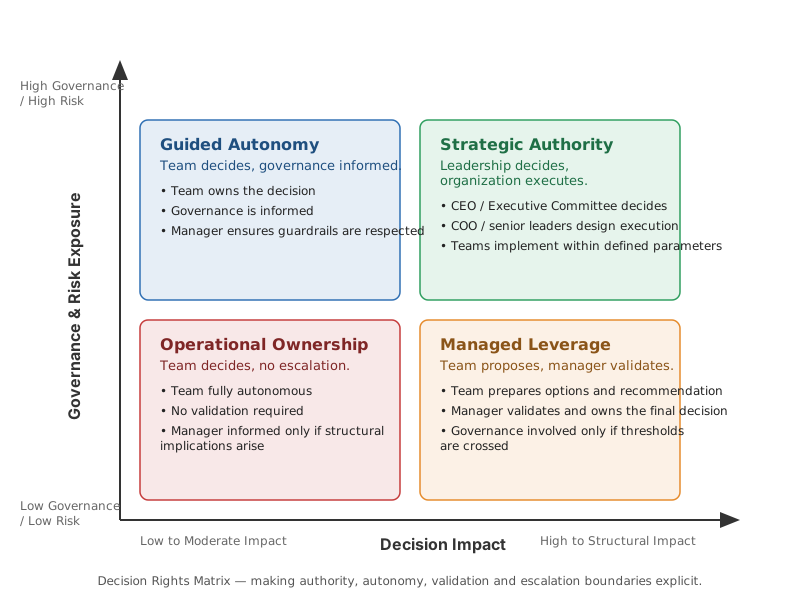
A decision rights matrix makes the organization’s decision architecture visible: which decisions teams can take autonomously, which require information or validation, and which remain with management.
 />
/>
Decision Rights Matrix — making authority, autonomy, validation and escalation boundaries explicit.
The value of the matrix is not documentation. It is diagnosis. It reveals where decision rights have drifted, where autonomy has disappeared, and where escalation has become a substitute for authority.
The critical distinction is simple: accountability identifies who owns the outcome; decision rights identify who can actually act.
When Escalation Becomes a Structural Problem
Escalation is not inherently dysfunctional. Some decisions should move upward because they exceed the authority, risk tolerance, or information available at a lower level.
The problem begins when escalation becomes the default mechanism for resolving ambiguity. When employees repeatedly escalate decisions that should be taken autonomously, managers become overloaded with operational decisions. The organization gradually centralizes without formally deciding to centralize.
At the same time, employees learn that taking initiative creates risk while escalation creates protection.
The result is a self-reinforcing cycle:
- Decision boundaries become unclear.
- Teams escalate more frequently.
- Managers become decision bottlenecks.
- Managers introduce additional controls.
- Teams perceive less autonomy.
- More decisions are escalated.
What appears to be a behavioral problem is therefore often the consequence of structural ambiguity.
The Cognitive Impact on CEOs and COOs
Decision architecture has a direct cognitive impact on leadership.
A COO who once navigated decisions intuitively may find that increasingly simple decisions require clarification. A CEO who previously sensed the organization’s operating rhythm may begin to experience a persistent feeling of misalignment.
Decisions take longer. Escalations increase. Managers become overloaded. Teams appear hesitant even when they are technically competent. The leadership response is often to increase communication, add meetings, introduce more reporting, or intervene more directly.
But these responses can unintentionally reinforce the underlying problem by increasing centralization rather than restoring decision rights. This cognitive friction is not necessarily a leadership failure.
It is often a structural signal.
Case Study: When Accountability Was Clear but Decisions Still Failed
A European financial services company faced a puzzling pattern: teams were accountable, competent, and adequately staffed — yet decisions stalled across the organization.
Managers were overwhelmed with escalations. Projects slowed. Compliance interpretations multiplied. The CEO described the organization as hesitant but could not identify a single underlying cause. A structural diagnostic revealed that decision rights had drifted.
Teams were accountable for outcomes but lacked sufficient authority to make the decisions required to deliver them. Managers were validating decisions that should have been taken autonomously. Compliance expectations were being transmitted partly through informal channels, creating uncertainty about what genuinely required validation.
At the same time, digital tools had created parallel decision pathways that bypassed established governance structures. The organization therefore had accountability, governance, technology, and competent people — but the elements no longer formed a coherent decision architecture.
A Rapid Clarity™ intervention rebuilt the decision architecture by making decision rights explicit, simplifying governance boundaries, clarifying escalation pathways, and restoring autonomy where appropriate.
The result was not simply faster decision-making. Managers regained cognitive bandwidth, teams regained operating autonomy, and the organization recovered greater coherence between accountability and authority.
Why Structural Drift Is Difficult to See from Inside
Decision-rights failures are often difficult to diagnose from within the organization because the people operating inside the system have already adapted to its constraints.
Employees compensate for ambiguity through informal agreements. Managers create workarounds. Teams develop parallel approval channels. Executives intervene selectively. Over time, these adaptations become normalized. The organization can therefore appear to be functioning while its formal operating model and its actual decision architecture progressively diverge.
An external operating-model intervention can help make this divergence visible because it examines the organization from outside the assumptions and routines that produced the drift.
Decision Architecture and Rapid Clarity™
The purpose of Rapid Clarity™ is not to improve individual decisions in isolation. It is to establish the structural conditions under which sound decisions can consistently be made.
That means identifying where decision rights sit, where authority has become ambiguous, where governance has become excessive, and where information flows no longer support the decisions the organization expects people to make.
Rapid Clarity™ is therefore not about improving decisions. It is about restoring the structure that makes decisions possible.
Conclusion: Decision Rights Are the Hidden Architecture of Execution
Organizations do not necessarily fail because people lack accountability. They often fail because accountability, authority, decision rights, governance, and information have become structurally disconnected.
When that happens, decisions slow down, escalation increases, managers become bottlenecks, and leadership begins compensating for structural problems through greater intervention.
The resulting symptoms can look behavioral: hesitation, indecision, lack of ownership, excessive escalation, or weak leadership.
But beneath those symptoms may be a much simpler structural problem:
The person accountable for the outcome does not necessarily have the authority and decision rights required to achieve it. Restore that alignment, and the organization can begin to recover decision velocity, managerial capacity, and operating coherence.
>