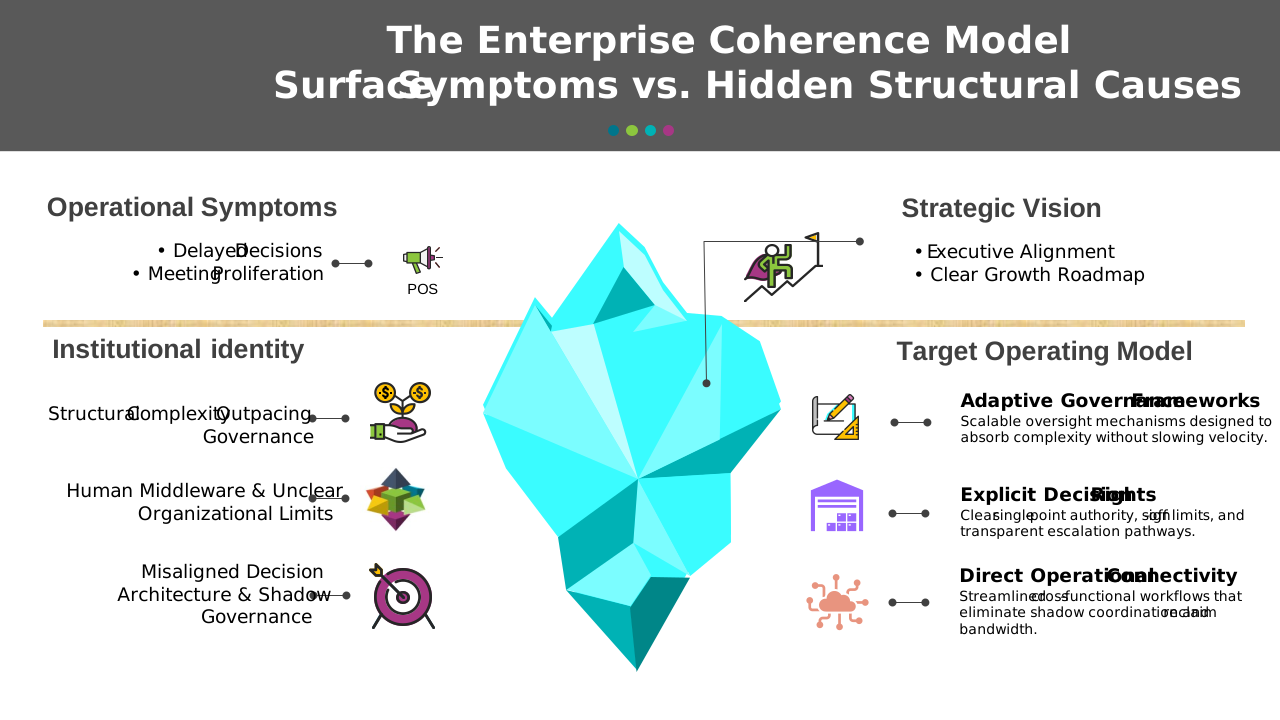
The Hidden Operating System of Business
Every executive leadership team recognizes the symptoms. Strategic initiatives take longer than budgeted, decisions that once required hours stall for weeks, and meetings consume an ever-larger share of the calendar while producing diminishing clarity. Teams remain visibly active, yet execution feels inconsistent. Revenue may continue to grow, but margins drift downward, and operational predictability erodes.
For many chief executives, these challenges appear unrelated. Each issue is routinely assigned to a different business unit, a different leader, or a different market condition—under the assumption that the enterprise faces a series of isolated hurdles to be cleared one at a time.
In reality, expanding organizations rarely fail because of an isolated operational flaw. They struggle because the underlying mechanisms linking strategy, leadership, decision rights, accountability, and execution have gradually fallen out of alignment. What presents as routine operational friction is almost always the visible surface of a deeper structural defect.
The View Above the Line: Why Tactical Fixes Fail
Organizations experience structural drag through immediate pain points: delayed sign-offs, conflicting functional priorities, recurring escalations, and an unsustainable reliance on a small circle of senior executives.
In response, leadership typically targets the visible symptoms. Meeting cadences are redesigned, reporting layers are added, new software tools are deployed, and management interventions are launched. While well-intentioned, these measures frequently fail to deliver lasting relief because the underlying operating model remains unchanged.
The visible symptoms attract executive focus because they disrupt daily operations. The root causes remain submerged beneath the waterline because they are embedded in how the enterprise functions, shaping decision rights, communication flows, authority boundaries, governance mechanisms, and performance expectations.
Organizations rarely suffer from a lack of effort. They suffer from operating systems that can no longer support the complexity of the business.
The Six Components of Enterprise Architecture
To perform consistently at scale, an enterprise must align six interconnected dimensions:
| Operational Friction & Surface Symptoms |
Systemic Intervention & Target Architecture |
| Strategy: Clear market positioning and resource allocation priorities. |
Leadership: Executive capabilities that reinforce rather than bypass the operating model. |
| Governance: Explicit decision rights, sign-off limits, and escalation triggers. |
Performance Management: Metrics that provide genuine operational visibility rather than passive reporting. |
| Organization: Structural alignment that eliminates unnecessary matrix complexity. |
Execution: Direct lines of accountability that turn strategic intent into operational outcomes. |
When these components fall out of alignment, the consequences are rarely confined to a single department. Weak governance manifests as execution delay; flawed organizational design undermines leadership effectiveness; and misaligned performance management dilutes strategic focus.
The Paradox of Scale: Growth and Structural Fragility
One of the defining paradoxes of enterprise growth is that expansion exposes architectural weaknesses long before they manifest in financial performance. In an enterprise’s formative stage, execution velocity relies on proximity. Teams occupy shared spaces, information moves organically, and decision-making is informal. The founder or key executive acts as the primary connective tissue, compensating for structural omissions through personal oversight and continuous intervention.
As the enterprise expands, informal practices become impossible to sustain. The executive whose hands-on leadership once accelerated decisions becomes the primary organizational bottleneck. Direct communication fragments into siloed interpretation, operational flexibility turns into strategic inconsistency, and entrepreneurial speed deteriorates into execution drag. The enterprise becomes a victim of the exact operating logic that enabled its early momentum.
Diagnosing Root Causes: Distinguishing Symptoms from Sources
A primary discipline of executive leadership is the capacity to differentiate surface-level symptoms from foundational architectural defects:
-
Decision Paralysis: Signals ill-defined decision boundaries rather than indecisive executive talent.
-
Executive Overload: Reflects an operating model structurally reliant on founder-led intervention.
-
Stalled Strategic Initiatives: Points to inadequate governance frameworks rather than poor project management.
-
Functional Friction: Originates from conflicting organizational incentives rather than interpersonal dynamics.
-
Margin Compression: Stems from underlying performance management gaps rather than market conditions alone.
Treating symptoms in isolation consumes capital without altering the enterprise's trajectory. Lasting performance improvement occurs only when leadership addresses the architectural conditions that allow operational drag to manifest in the first place.
Sustainable enterprise value is built when leaders stop asking their teams to work harder and begin re-engineering how the system functions.
The Chief Executive’s True Imperative
While business literature frequently frames chief executive leadership as an exercise in vision, vision alone cannot drive execution. The primary challenge for modern CEOs is not merely determining where the organization should go, but ensuring the enterprise possesses the structural capability to get there.
That capability requires deliberate alignment across strategy, governance, organizational architecture, leadership, and performance management. When these elements reinforce one another, the enterprise acquires genuine resilience. Decision velocity accelerates, accountability becomes self-enforcing, and execution predictability rises, liberating the chief executive to focus on long-term growth .
Benchmark Your Operating Model for Structural Coherence
Assess decision velocity, identify coordination drag, and map the explicit path from operational friction to organizational resilience.
Evaluate whether your operating model is built for sustainable growth or sustained by executive burnout. Engage with our Rapid Clarity™ Diagnostic to identify hidden decision bottlenecks, map structural dependencies, and establish a clear blueprint for organizational coherence.
References
-
Bain & Company: The Decision-Driven Organization; Empirical research mapping the direct link between explicit decision architecture, execution velocity, and long-term margin growth.
-
McKinsey & Company: Organizing for the Future: Nine Keys to Becoming a Fast-Flowing Organization; Analysis on how removing internal coordination drag and matrix complexity restores enterprise velocity.
-
Harvard Business Review: Stop the Decision Overload; Strategic evaluation of how shadow governance and consensus-driven cultures destroy capital efficiency in scaling firms.