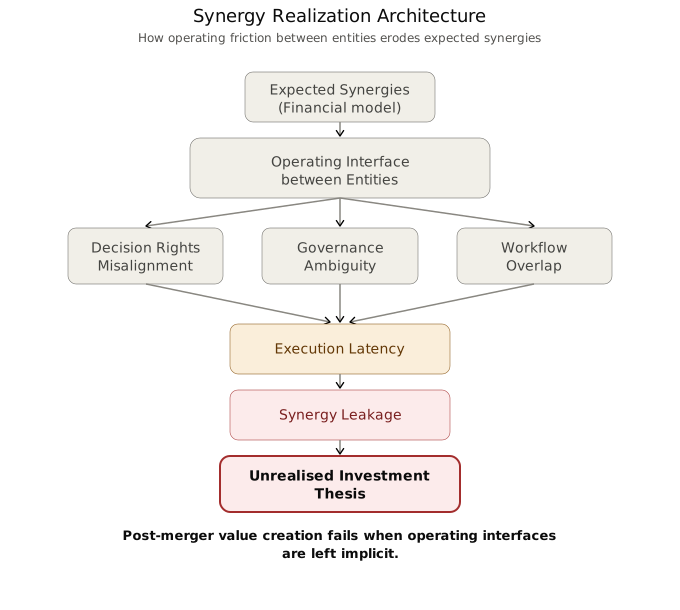
Post-Merger Integration Architecture
PMI Structural Integration Friction & Synergy Leakage
Most acquisition models assume that synergies will emerge once ownership changes. In practice, ownership is only the beginning.
After closing, two organisations must determine how decisions will be made, where authority will reside, which activities will be standardised, and how accountability will be shared. Until those questions are resolved, integration remains incomplete regardless of legal structure or financial reporting.
The consequence is rarely dramatic failure. It is usually a gradual erosion of value. Decisions slow. Initiatives stall. Managers spend increasing amounts of time negotiating responsibilities instead of creating results. Synergies remain theoretically available but operationally inaccessible.
What appears to be an integration challenge is often a structural one. The issue is not whether two organisations want to work together. The issue is whether they possess an operating architecture capable of doing so.
Why Synergies Frequently Underperform Expectations
Most post-merger integration programmes focus on activities. Teams, workstreams, milestones and projects are carefully planned. Yet many integrations that appear successful on paper struggle to deliver the economic outcomes anticipated during acquisition.
The reason is often hidden in the organisation's design. Before acquisition, both businesses evolved independently. Each developed its own management logic, escalation pathways, governance practices and operating assumptions. These differences are rarely visible in organisational charts, but they become critically important once integration begins.
As companies attempt to combine operations, structural inconsistencies emerge. Decision rights overlap. Functional ownership becomes unclear. Similar activities are performed differently across entities. Managers become intermediaries between systems that were never designed to operate together.
The resulting friction is rarely captured in integration dashboards. Nevertheless, it directly affects how quickly synergies can be realised.
The question is therefore not simply how to integrate businesses. It is how to integrate operating architectures.
The Hidden Sources of Integration Friction
When integrations fail to realise expected benefits, the causes are frequently attributed to culture. Cultural explanations are attractive because they are easy to understand and difficult to measure.
The evidence inside most portfolio companies tells a different story. The first source of friction is duplicated authority. Business units often operate under multiple approval structures inherited from both organizations. Decision-making becomes slower because ownership has not been explicitly redefined.
The second source is operational overlap. Similar functions continue operating independently because no target operating architecture has been established. Teams duplicate effort while the expected efficiencies remain unrealized.
The third source is management arbitration. Senior leaders spend increasing amounts of time translating expectations, resolving conflicts and coordinating between disconnected teams. Integration relies less on systems and more on individual intervention.
The fourth source is governance inconsistency. Reporting structures, escalation routes and performance management mechanisms differ across the combined organization. This creates ambiguity precisely where clarity is most needed.
None of these issues appears particularly significant when viewed individually. Together, however, they create a persistent drag on execution. The organization may technically be integrated while continuing to operate as separate entities beneath the surface.
Integration Success Depends on Operating Design
Private equity firms devote substantial effort to validating commercial assumptions, estimating synergies and planning integration activities. They typically devote much less attention to the structural mechanisms required to enable those outcomes.
This imbalance explains why synergy capture often takes longer than anticipated. Synergies are economic outcomes. They are not operating mechanisms.
Before savings can be realised or revenue opportunities captured, the organisation must first establish clarity around authority, accountability and coordination. These elements determine whether integration accelerates performance or simply increases complexity.
The distinction becomes particularly important in buy-and-build environments. As acquisition activity increases, unresolved structural issues compound across the platform. What begins as a small integration challenge can evolve into a portfolio-wide operating constraint.
The most successful platform companies therefore treat operating architecture as a strategic asset rather than an administrative consideration.
They recognize that scalable integration requires repeatable organizational logic, not merely effective project management.
Three Dimensions of PMI Structural Friction
PMI structural friction typically manifests across three interconnected dimensions.
-
Operating Model Misalignment: Processes, responsibilities, and workflows continue to reflect pre-acquisition realities, preventing the emergence of a coherent operating model.
-
Decision Architecture Conflicts: Authority remains fragmented across legacy structures, slowing execution and creating uncertainty around ownership.
-
Governance & Coordination Drag: Management attention shifts away from value creation and towards the manual coordination of activities that should already be embedded within the organization.
Understanding where friction exists across these dimensions provides a clearer picture of integration risk than cultural assessments alone.
The Bottom Line
Integration does not occur because ownership changes. It occurs when two organizations develop a shared operating logic capable of supporting coordinated execution.
Where operating interfaces remain unclear, value creation slows, and synergies leak. Where accountability, governance, and decision rights are deliberately aligned, expected synergies become operationally achievable. The difference between integration success and integration frustration rarely lies in strategic intent; More often, it lies in organizational design.
Most integration challenges presented as cultural issues are, in reality, unresolved questions of operating architecture.
Diagnose Structural Integration Friction
Many integration challenges become visible only after momentum has already been lost.
Assess where operating model conflicts, governance overlaps and decision bottlenecks may be slowing synergy realisation across your portfolio.