Pre-Acquisition Organizational Architecture Audit
The Risks Financial Due Diligence Cannot See
Two companies may report identical revenue growth, margins, and cash generation while carrying profoundly different operational risks.
One relies on repeatable systems, institutional knowledge and clearly defined accountability. The other depends on a handful of individuals, informal workarounds and undocumented operating practices that have accumulated over years of growth.
Financial due diligence will typically identify the difference in performance.
It rarely reveals the difference in resilience.
Organizational debt accumulates when businesses adapt faster than their operating architecture evolves. Critical processes become dependent on individuals. Decision-making becomes concentrated. Informal coordination replaces institutional mechanisms.
These liabilities seldom appear in financial statements, yet they frequently determine whether post-acquisition value creation accelerates or stalls.
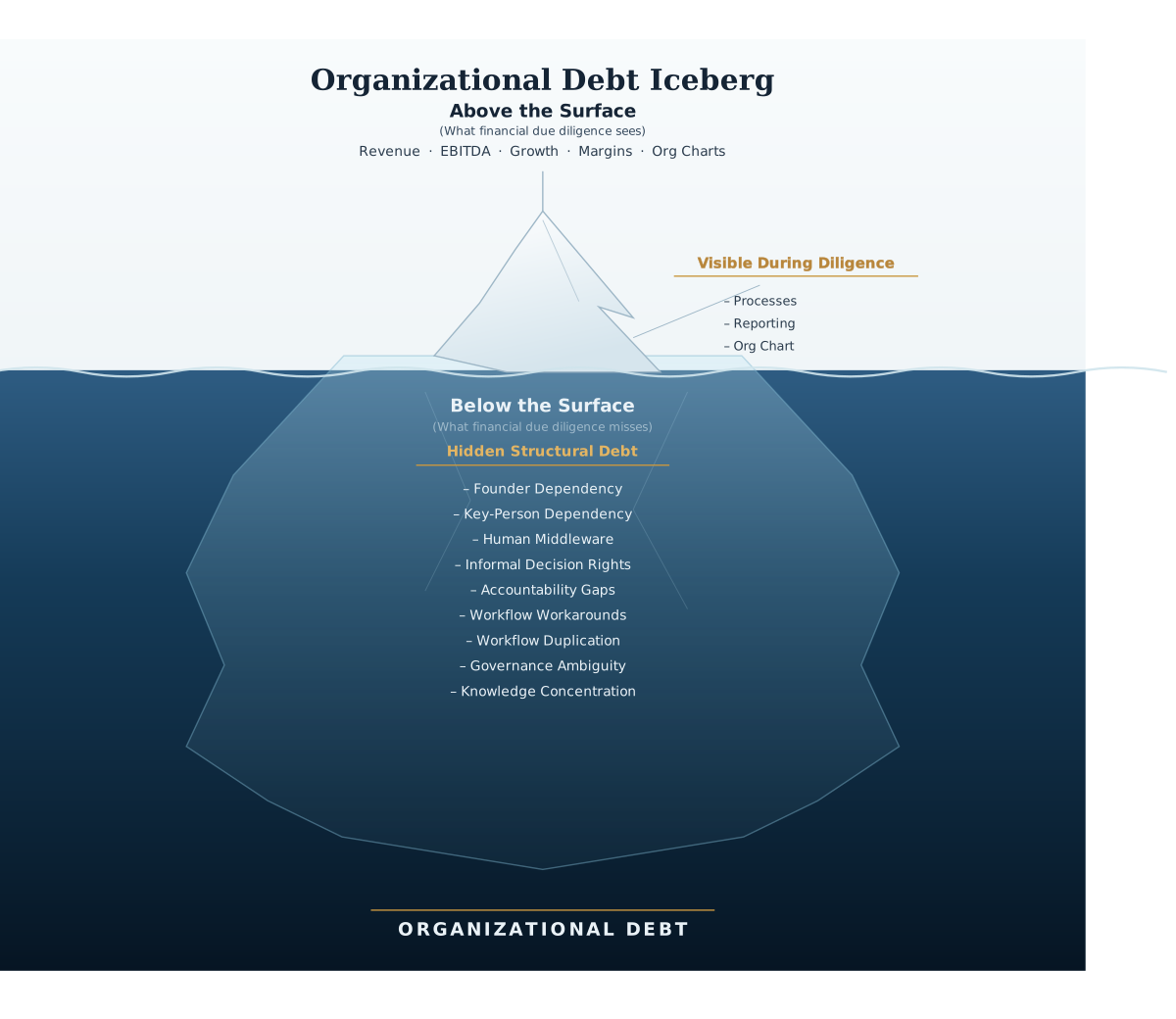
Some liabilities sit on the balance sheet. Others sit inside the organization itself.
Traditional due diligence validates the spreadsheet. Structural due diligence validates the operating machine that has to deliver the investment thesis.
Why Structural Risk Often Remains Hidden Until After Close
Private equity transactions devote considerable attention to financial, commercial, and legal risk. Each plays a critical role in validating the investment thesis.
Yet many of the most consequential risks emerge only after ownership changes hands.
A founder departs, and operational knowledge disappears with them. Growth initiatives require approvals from an unexpected range of stakeholders. Integration programmes expose undocumented processes that no one fully understands. Senior executives become overwhelmed by issues that should never have required their involvement.
These situations are rarely caused by poor management. More often they are manifestations of organizational debt accumulated over time.
Like technical debt in a software system, organizational debt develops when short-term adaptations gradually become embedded in the way the business operates. Individual heroics replace scalable processes. Informal relationships replace clearly defined interfaces. Responsibilities overlap because nobody was forced to clarify them during periods of growth.
While these arrangements may function adequately under existing ownership, private equity often accelerates the pace of change sufficiently to expose their limitations.
Acquisitions, integrations, reporting requirements and transformation initiatives place additional pressure on operating structures that were never designed to support them.
The result is frequently mistaken for an execution problem. In reality, it is often an inherited structural liability.
The Hidden Forms of Organizational Debt
Organizational debt presents itself in several recurring forms.
One of the most common is key-person dependency. Critical decisions, customer relationships, or operational knowledge become concentrated within a small number of individuals. The organization remains functional, but only because particular people continue to compensate for structural weaknesses.
A second form appears as human middleware. Information, approvals, and decisions move through specific individuals because systems, processes, or reporting lines fail to connect effectively. These individuals become indispensable not because of hierarchy, but because they are continuously bridging organizational gaps.
Governance ambiguity represents another common liability. Responsibilities appear clear on organizational charts but remain unclear in practice. Escalation pathways overlap. Decision rights become negotiable rather than explicit.
Workflow duplication is equally prevalent. Different teams maintain parallel processes to achieve the same objective because no coherent operating design has emerged organically. Individually, these issues may seem manageable. Collectively, they create a form of structural handicap that increases organizational fragility as complexity grows.
The challenge is not that the organization cannot perform. It is that its performance depends on mechanisms that do not scale predictably.
Why Organizational Debt Matters to Private Equity Investors
Private equity ownership introduces conditions that quickly expose structural weaknesses.
Growth initiatives increase coordination demands. Integration programmes create new interfaces between teams and entities. Reporting requirements accelerate information flow through the organization. Leadership is expected to make decisions more rapidly while managing increased complexity.
Where organizational debt exists, these additional demands rarely produce proportional results.
Instead, the underlying liabilities become amplified.
Decision-making slows because accountability remains unclear. Integration takes longer than expected because operating models were never fully institutionalized. Management teams become overloaded as informal coordination mechanisms struggle to support greater scale.
This creates an important distinction for investors. The question is not simply whether a company performs well today. The more relevant question is whether the operating architecture supporting that performance remains viable under the conditions required by the investment thesis.
Many portfolio challenges attributed to execution originate from structural liabilities that existed before acquisition. Understanding them early changes both risk assessment and value creation planning.
The Organizational Debt Iceberg
The deeper these dependencies run, the greater the disconnect between reported performance and institutional resilience.
To prevent inherited operational liabilities from derailing value creation post-close, we deploy a targeted Pre-Acquisition Organizational Architecture Audit:
- Phase 1: Informal Network & Authority Mapping (expose hidden bottlenecks): Deploy the 12 Organizational Maps™ to visualize real-world decision pathways, informal gatekeepers, and key-person concentrations beyond the official org chart.
- Phase 2: Human Middleware & Friction Diagnostic (isolate manual coordination): Identify where senior talent is being consumed by spreadsheet reconciliation, informal escalation loops, and inter-departmental arbitration.
- Phase 3: Target Operating Model (TOM) & RACI Codification (hardwire structural resilience): Establish explicit single-point decision rights, formalize cross-functional interfaces, and empower middle management to execute independently.
What Structural Due Diligence Gives Each Side of the Deal
- For PE deal teams and M&A directors: organizational risk made visible before close, so it can inform the purchase price, SPA representations and earn-out structures.
- For operating partners: a validated view of where the 100-day plan will meet resistance, before the first day of ownership rather than weeks into it.
The Debt You Acquire Alongside the Business
Every acquisition transfers more than assets, contracts, and financial performance. It also transfers the operating architecture through which the business actually functions.
Where that architecture relies on individual intervention, informal mechanisms, or undocumented dependencies, organizational debt accompanies the transaction whether investors recognize it or not.
The objective is therefore not simply to identify operational weaknesses. It is to understand whether organizational performance is supported by scalable institutional capability or by fragile structures that have yet to be tested under the demands of ownership change.
In many cases, the most significant risks are not hidden in the financial statements. They are hidden within the organization itself.
Identify Organizational Debt Before It Becomes Execution Drag
Many post-acquisition challenges can be traced back to structural liabilities that existed long before the transaction closed.
Explore the underlying forms of organizational debt and assess where hidden dependencies may be creating risk within the business.