FINANCIAL HISTORY & MACROECONOMICS
The Scale Trap: When Billions Lose Their Meaning
Trillion-dollar valuations and mega-capex used to signal progress. In a low-growth economy, they signal disconnect. Have we become so blind to scale that value no longer registers?
In 1995, IBM’s $3.5 billion acquisition of Lotus Development Corporation made global front-page news. It was analyzed by markets and regulators as an extraordinary concentration of corporate capital.
Today, a figure of that magnitude is deployed across venture capital tables before lunch. Artificial intelligence startups capture billions within weeks of launch, tech conglomerates command market valuations surpassing the GDP of entire G7 nations, and public debt is measured in trillions.
Yet as these figures balloon, they have lost their power to register. The most consequential economic shift of the past three decades may not be the expansion of global liquidity itself, but something far more subtle and corrosive: the gradual destruction of our intuitive grasp of what monetary scale actually represents in the real economy.
When Scale Severs Reality
Economic metrics are designed to act as accurate mirrors of material reality. A dollar, or a billion of them, is meant to function as a stable unit of account, a medium of exchange, and a reliable measure of utility and productivity. Yet history demonstrates that economic systems periodically enter phases where units of account detach entirely from the underlying assets they are intended to quantify.
When this disconnection takes hold, value becomes nearly impossible to benchmark or calibrate. The consequences extend well beyond analytical confusion for central bankers and fund managers; they erode the basic social fabric of trust.
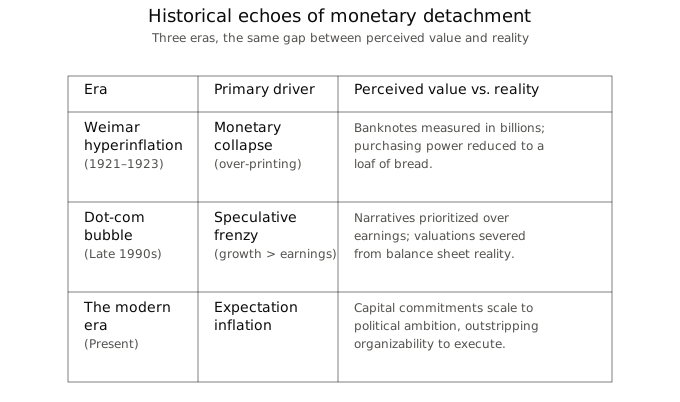
During the hyperinflation of Weimar Germany between 1921 and 1923, citizens carried wheelbarrows of banknotes denominated in billions of marks to purchase basic provisions. The failure was not a sudden shortage of wheat or bread, but the complete breakdown of money as a reliable symbol of work and worth. The digits remained legible, but their underlying meaning evaporated.
Three decades later, the late-1990s dot-com bubble presented a corporate variant of the same disease. Financial markets began valuing speculative narrative over audited cash flow. Capital chased promise at speeds that outstripped operational capacity, and growth rates replaced profit margins as the core metric of corporate viability.
Today’s phenomenon bears traits of both precedents, yet it is distinct. The tech titans dominating contemporary markets are not phantom enterprise shells; they generate real revenues, control crucial digital infrastructure, and command immense technological capabilities. This is not a classic speculative mania driven by worthless assets.
Yet the underlying diagnostic remains troubling: Are modern markets measuring actual economic productivity, or are they merely recording the velocity with which excess capital cascades toward perceived strategic monopolies?
The Social Fracture: Thousands vs. Billions
The societal consequences of this rift are visible in historical precedent. Argentina’s decades-long struggles with currency instability demonstrate how chronic inflation destroys the shared baseline of economic life. As digits multiplied on official ledgers, public policy debates increasingly gravitated toward abstract macro-statistical targets. Meanwhile, everyday citizens found themselves alienated from an economic discourse that bore no connection to their daily lives.
A similar division is emerging across Western democracies. Policy debates, financial commentary, and technology keynotes take place in a realm of hundreds of billions and trillions. Yet everyday households evaluate economic health through much smaller, rigid constraints:
-
Monthly take-home pay;
-
Mortgage payments and rent;
-
Energy bills;
-
Real purchasing power at the supermarket checkout.
Put simply: institutional elites operate in billions, while citizens survive in thousands.
When these two frames of reference diverge too far, trust in markets, governance, and public institutions inevitably erodes. The public does not lose faith because it fails to grasp advanced financial theory; it loses faith because the official narrative no longer reflects any recognizable physical reality.
The Present Interlink: Mega-Capital in a Sluggish Economy
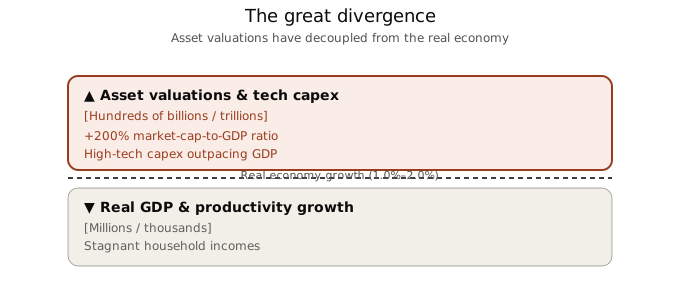
To understand why this detachment is happening today, one must look directly at the Great Divergence: the historical gap between the unprecedented accumulation of financial assets and the sluggish, ultra-low economic growth of the broad real economy.
Today’s financial headlines exist in a state of macroeconomic cognitive dissonance:
- In the financial realm: Total market capitalization relative to GDP has shattered historical records. A handful of technology giants command multi-trillion-dollar valuations, hyperscale capex spending on AI infrastructure regularly crosses hundreds of billions annually, and venture capital mega-rounds occur in rapid succession.
- In the real economy: Global GDP growth remains stubbornly weak. Most advanced economies are locked in a low-growth rut (often 1.0% to 2.0% annually), weighed down by aging demographics, structural debt, and stagnant real wage growth.
This is where the thesis interlinks directly with current conditions: The swelling numbers in technology, government industrial policy, and capital markets are no longer driving broad-based growth.
Instead of capital flowing through the real economy to raise overall living standards, it is concentrated in an "asset canopy", a top-heavy layer where capital circulates among sovereign wealth funds, mega-tech platforms, and private equity firms.
Structural Roots of the Separation
Several factors explain why today's ultra-low growth environment coexists with unprecedented financial scale:
1. Capital-Heavy vs. Labor-Heavy Expansion
In the mid-20th century, a multi-billion-dollar industrial expansion meant building factories, hiring tens of thousands of workers, and paying wages that trickled down into main-street GDP.
Today's multi-hundred-billion-dollar capital investments are concentrated in capital-intensive, low-labor sectors, primarily silicon, data centers, energy infrastructure, and software algorithms. A $50 billion data center investment creates vast asset value, but relatively few direct permanent jobs compared to its monetary scale.
2. The Inflation of Expectations
The primary economic distortion of our time is less monetary inflation than expectation inflation. Twenty years ago, compounding a firm's market value twofold over five years was considered an exceptional managerial achievement. In today’s market, venture capital funds demand decacorns ($10 billion valuations) out of the gate, while equity analysts routinely bake near-limitless productivity returns into the forward earnings multiples of AI firms.
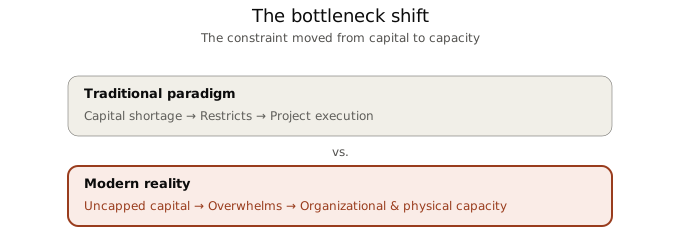
As a result, capital is accumulating faster than organizational management can absorb it. The binding constraint on modern economic growth is no longer a shortage of liquid capital, but the physical, regulatory, and operational limits of execution.
Comparing Epochs: The Structural Shift
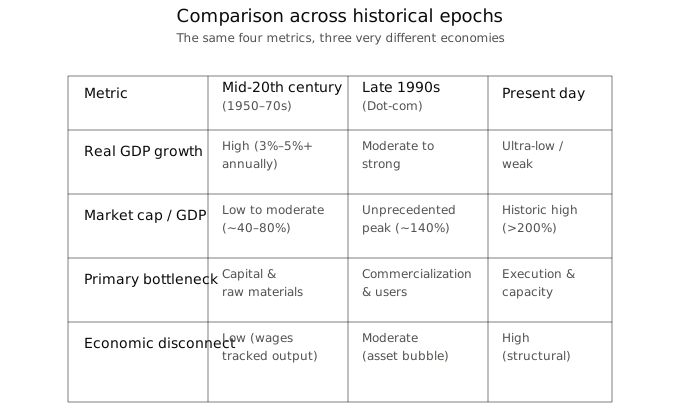
Comparing today's economic landscape with historical periods reveals distinct differences in how monetary scale interacts with real growth:
The Post-WWII Boom (1950s–1970s): High Growth, Grounded Scale
A "billion dollars" was an extraordinary sum, but when governments or firms deployed capital, it yielded broad productivity gains across the economy. Economic figures were anchored to tangible physical outputs, tons of steel, miles of highway, and growing workforces. Wage growth matched productivity, ensuring society shared a single economic reality.
The Dot-Com Era (Late 1990s): Speculative Heat in a Growing Economy
Market valuations detached from earnings, but underlying economic growth was still solid (US GDP grew at 4%+ in the late 90s). The dot-com boom was a speculative bubble built on top of a healthy real economy. When the bubble burst, the broader productive capacity remained intact.
Today: Financial Hyper-Scale in a Stagnant Economy
The current period combines record financial scale with low underlying economic growth. Unlike the dot-com era, today's megacaps generate massive cash flows. However, this capital remains insulated inside a narrow technology and financial loop. It generates eye-watering headlines ($100 billion AI clusters, $3 trillion market caps) while the average household faces persistent pressure on real purchasing power.
Scale as Political Theatre
When financial metrics drift away from physical reference points, they stop functioning as objective measurements and become political theater. Corporate executives and government ministers are no longer judged on the operational performance or cost-efficiency of a project, but on the sheer magnitude of the capital commitment announced at a press conference.
This dynamic gives rise to a competitive escalation of scale:
- $1 billion signals mere maintenance;
-
$10 billion establishes seriousness;
-
$100 billion demonstrates regional ambition;
-
$500 billion buys geopolitical muscle.
The fundamental economic question, "What precise capital is required to deliver this infrastructure or software efficiently?", is quietly supplanted by a political one: "What figure must we publish to signal absolute dominance?"
This institutional distortion is accelerated by an unprecedented alignment among three governing classes: political leaders seeking national champions, financial managers seeking management fees on massive funds, and technology founders seeking market dominance.
Politicians demonstrate vigor through monumental spending packages. Investors show vision through mammoth capital allocations. Tech executives secure competitive moats through astronomical capital expenditure plans. The resulting incentive structure guarantees a steady stream of record-breaking headline numbers, each designed to eclipse the last.
Reclaiming the Anchor
The central challenge facing modern economies is not simply managing monetary inflation or adapting to rapid automation. It is the widening chasm between the astronomical scale at which institutions commit capital and the grounded scale at which human beings live.
Capitals and capital markets alike run the risk of mistaking financial scale for economic substance. Modern economies depend on a shared understanding of value to remain stable. When that shared baseline dissolves into abstract billions, the social contract deteriorates alongside it.
The vital question for the coming economic decade is straightforward: In our pursuit of ever-larger figures, have we lost the ability to recognize what real value looks like?
Key Executive Takeaways
- The Abstraction of Capital: Modern markets routinely trade in figures so large that they have detached from physical execution capabilities, turning monetary scale into a metric of narrative power rather than productivity.
-
The Execution Bottleneck: In an era of hyper-concentrated capital, economic progress is no longer limited by the availability of funding, but by physical, regulatory, and organizational capacities to deploy it effectively.
-
The Macro Disconnect: Current ultra-low GDP growth coexists with record-high market-cap-to-GDP ratios, creating a structural split between asset markets and Main Street.
-
The Elite Disconnect: A growing divide between institutional decision-makers operating in billions and citizens managing household budgets in thousands poses a structural threat to public trust and social stability.