The Macro Disconnect
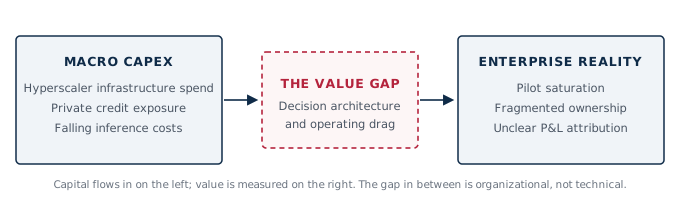
Financial institutions face a rapid fall in the unit cost of inference alongside record capital commitments for infrastructure. Many find themselves locked into expanding software licensing commitments without a clear gate to verify whether pilot programs translate into balance-sheet value or operational efficiency.
Figure 1: The structural rift between macroeconomic capital expenditure and enterprise return on investment.
Three Structural Risks for Financial Institutions
In financial services, where risk management, regulatory compliance and capital allocation are paramount, this disconnect exposes institutions to three immediate structural risks:
- Capital allocation inflation: continuing to fund exploratory projects without enforced P&L realization benchmarks.
- Governance bottlenecks: overlapping decision rights between IT, compliance and business units that slow execution and dilute ownership.
- Operating model drag: layering automated tools on top of legacy workflows without redesigning the underlying organizational architecture.
Market Reality Check: Bull-Run Correction or Structural Pivot?
The recent volatility across AI-heavy market indices raises a critical question for the C-suite: is this a natural digestion phase after a historic bull run, or the beginning of a structural repricing?
EXECUTIVE ANALYSIS
Short-term pullbacks prune inflated valuations. But shifting policy in Washington, tighter credit spreads for infrastructure and investor fatigue over unproven returns point to a broader pivot: the market is moving from rewarding aggressive capex to demanding capital allocation discipline.
For financial institutions, this reset confirms an operational truth: external technological momentum can no longer substitute for internal decision architecture. Organizations that rely on third-party hype cycles to drive digital strategy risk write-downs when sentiment adjusts.
- Regulatory and energy friction: policy shifts are placing more scrutiny on supply chains, data sovereignty and energy allocation, directly altering infrastructure cost structures.
- The flight to quality: capital is moving away from exploratory pilots toward software that demonstrates immediate, defensible returns.
- Governance as a hedge: institutions with clear decision gates absorb market volatility smoothly; those with fragmented ownership face immediate budget friction.