Private Equity Operating Architecture
The Missing Layer Between Investment Strategy and Execution Performance
Private equity firms devote considerable attention to investment theses, value creation plans, operating reviews and leadership assessments. Yet many portfolio outcomes are ultimately determined by something far less visible.
Between strategy and execution sits the operating architecture of the business itself: the structures, decision rights, governance mechanisms, management spans and coordination models through which work actually gets done.
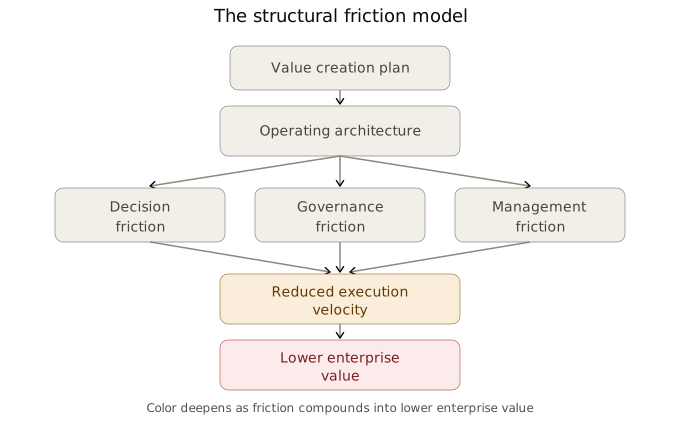
When this architecture is aligned, organisations absorb change, execute quickly and scale efficiently. When it is not, even strong leadership teams and compelling investment theses struggle to deliver expected outcomes. Decision-making slows, accountability blurs, integration efforts stall and management capacity becomes increasingly consumed by internal coordination.
Many of the challenges commonly treated as leadership issues, cultural issues or execution issues are, in reality, symptoms of an operating architecture that was never designed for the demands of a private equity hold period.
Why Portfolio Companies Struggle to Convert Strategy into Results
Private equity ownership imposes conditions that most organisations were never designed to accommodate.
Growth accelerates. Reporting requirements intensify. Acquisitions must be integrated. Decisions must be taken quickly. Management teams are expected to execute ambitious value creation plans while continuing to run the underlying business.
Under these conditions, organisational weaknesses that previously remained hidden become impossible to ignore.
A founder who once made every critical decision becomes a bottleneck. Functional leaders spend increasing amounts of time resolving conflicts between departments. New initiatives require approval from multiple stakeholders. Acquisition synergies fail to materialise despite universal agreement on strategic intent.
These problems often appear unrelated. In reality, they usually stem from the same underlying source.
The operating architecture of the organisation no longer matches the economic objectives imposed upon it.
The challenge is therefore not simply one of leadership capability, process efficiency or organisational culture. It is a question of whether the enterprise possesses the structural capacity required to support accelerated value creation
Most portfolio companies do not fail because their strategy is wrong. They struggle because their operating architecture cannot support the speed, complexity and coordination demands placed upon it.
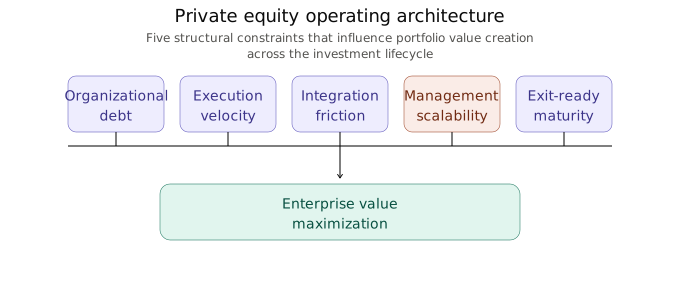
Five Structural Constraints on Portfolio Value Creation
Across private equity portfolios, five recurring patterns appear with remarkable consistency.
The first emerges before acquisition
Many businesses carry a significant amount of hidden organizational debt. Critical knowledge resides with a small number of individuals. Decision-making authority remains informal. Core operating processes depend on relationships rather than institutional mechanisms. These vulnerabilities rarely appear in financial due diligence, yet they can materially affect post-close performance.
The second appears during the first months of ownership
As investors seek rapid execution against the investment thesis, organizations frequently encounter decision drag. Governance structures designed for stability suddenly become obstacles to implementation. Meetings multiply. Escalations increase. Execution velocity declines precisely when momentum matters most.
The third emerges during integration activity
Buy-and-build strategies frequently assume that synergies will naturally follow ownership. In practice, integration success depends upon aligning operating interfaces, governance structures and accountability models. When those elements remain unresolved, expected synergies leak from the investment case.
The fourth becomes visible as businesses scale
Growth introduces complexity faster than management structures evolve. Leaders become informal coordinators between functions. Executive bandwidth becomes constrained. The organization increasingly depends on managerial intervention to sustain performance.
The fifth appears as the company approaches exit
Buyers and secondary sponsors examine whether performance depends upon institutional capability or individual effort. Businesses that operate through repeatable, scalable systems command greater confidence than those dependent upon founder oversight, informal workarounds, or executive heroics.
Viewed individually, these may seem like separate problems.
Viewed structurally, they represent different manifestations of the same architectural challenge.
Portfolio companies rarely fail because the strategy is wrong. They fail because the organisation cannot execute the strategy at the required speed.
Why Conventional Improvement Programmes Often Disappoint
When performance begins to stall, most organisations respond by introducing additional initiatives.
Transformation programmes are launched. Reporting is expanded. New management layers are added. Additional governance forums are created. External advisers are engaged to improve execution.
These interventions may address symptoms without addressing causes.
An organisation suffering from structural ambiguity will not become faster because it produces more reports. A management team overwhelmed by coordination demands will not become scalable simply by attending more meetings. An integration programme will not accelerate because executives communicate more frequently if underlying accountability remains unclear.
The common assumption is that stronger management will compensate for structural weakness.
Over time, the opposite tends to occur.
Management is increasingly focused on addressing flaws in the operating model. Leaders become organisational shock absorbers, spending valuable time manually connecting functions, resolving ambiguities and mediating decisions that should be embedded within the structure of the business.
True operating maturity emerges when organisational performance depends less on intervention and more on design.
The most effective portfolio companies are not those with the most talented executives. They are those whose operating architecture allows talented executives to focus on growth, allocation decisions and strategic priorities rather than on internal coordination.
Sustainable value creation occurs when organisational performance becomes a consequence of structure rather than a dependence on managerial heroics.
The Five Dimensions of Private Equity Operating Architecture
Framework overview
The operating architecture lens provides a consistent framework for understanding how organisational structure influences portfolio performance across the investment lifecycle.
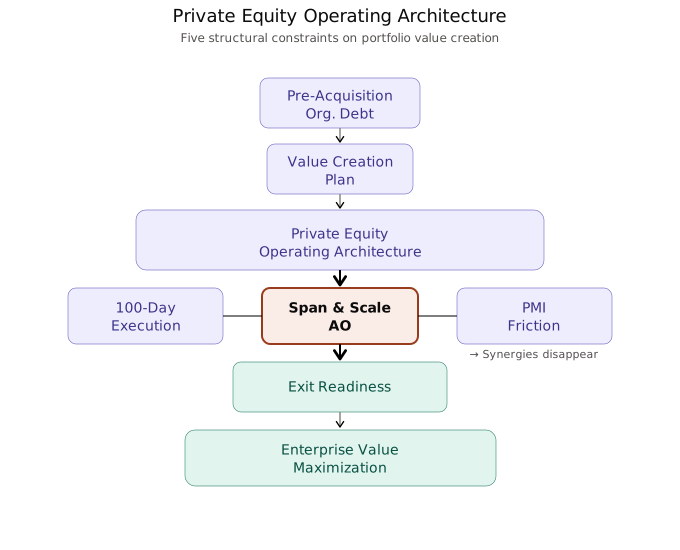
1. Pre-Acquisition Organisational Debt
Examines structural liabilities hidden beneath financial performance, including key-person dependency, unclear accountability and institutional fragility.
2. 100-Day Execution Velocity
Focuses on the organisation's ability to convert ownership change into execution momentum without becoming trapped in decision drag and governance overload.
3. PMI Structural Integration Friction
Explores why anticipated synergies fail to materialise when operating models, decision frameworks and management systems remain misaligned after close.
4. Management Span & Scalability Limits
Addresses the point at which organisational complexity exceeds management capacity and leadership becomes the primary bottleneck to growth.
5. Exit-Ready Operating Scalability
Evaluates whether performance is supported by institutional systems capable of sustaining growth beyond current leadership and ownership structures.
Together, these five dimensions form a coherent view of organisational readiness throughout the entire investment lifecycle.
The Architecture Beneath Portfolio Performance
Private equity firms understandably focus on transactions, leadership and strategy. These elements matter immensely.
Yet value creation is ultimately realized through organizations.
The quality of an investment thesis becomes relevant only when the enterprise possesses the structural capacity to execute it. Likewise, operational improvements can only produce lasting results when they are supported by a coherent and scalable operating architecture.
Understanding this architecture provides a different perspective on portfolio performance.
Instead of treating integration delays, management overload, execution friction and scalability challenges as isolated issues, they can be viewed as connected symptoms of an underlying structural condition.
The most effective operators recognise that organisational design is not an administrative concern.
It is a value creation mechanism.
Strategic intent creates direction. Operating architecture determines whether the organisation can get there.