Strategic Insight: AI OPERATIONS | ORGANISATIONAL DESIGN | THE NEW OPERATING MODEL
Why AI May Change Organizational Design More Than Individual Productivity
The conversation about artificial intelligence remains remarkably focused on individual productivity. AI helps people write faster, analyze faster, code faster, research faster, and produce more output in less time. Those gains are real, but they may turn out to be the least consequential part of the transformation.The more important question is what happens when AI begins to change not the work people perform, but the coordination required to make that work happen.
From Scale to Agency: How Technology Compresses Organizational Time
How successive technology waves transformed organisational capability
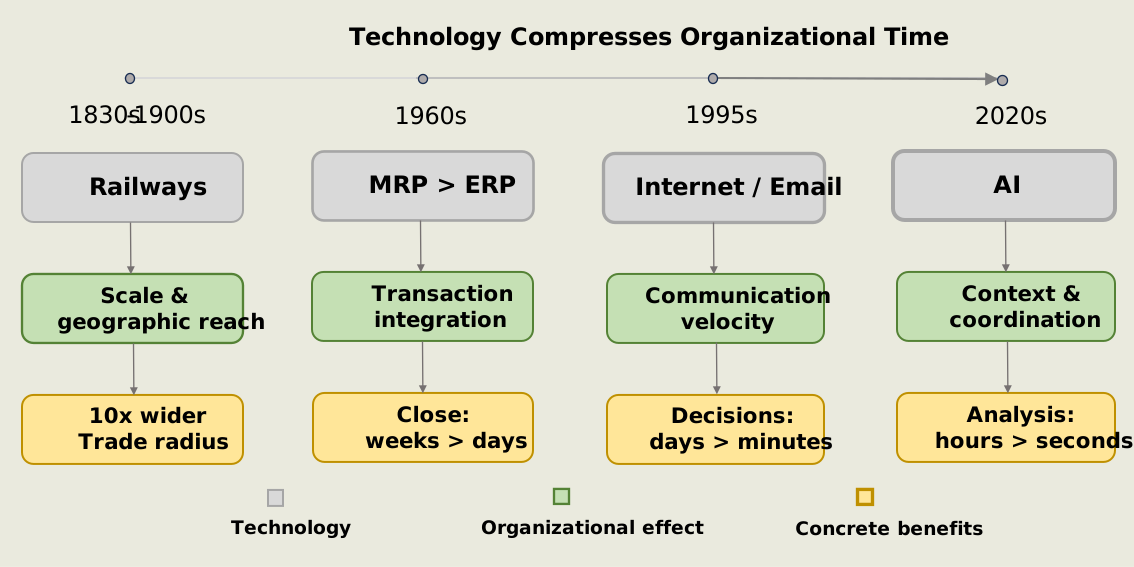
The next productivity breakthrough may not be another tool. It may be the disappearance of the work between the tools.
The hidden layer inside the modern organization
Over the past two decades, companies have built increasingly sophisticated technology stacks. Customer relationships sit in CRM systems; projects live in dedicated platforms; communication flows through email and messaging; knowledge is distributed across documents and collaborative workspaces; calendars coordinate time; dashboards report performance; financial systems record transactions.Yet the operating reality remains surprisingly manual; people bridge the gaps.
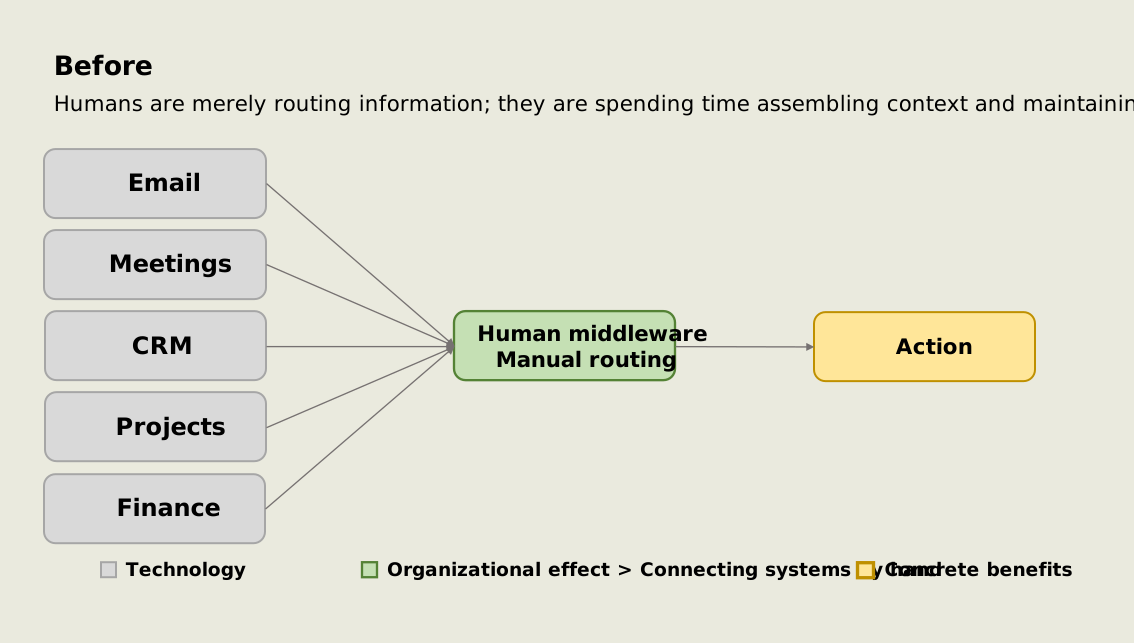
People are acting as middleware between systems that do not naturally understand one another. The information exists.The organization knows what happened. What is missing is a shared operational context.
Management accounts rarely include a line item labelled "information stitching". Instead, the cost appears as follow-up, reconciliation, reporting, status meetings, management reviews, and administrative effort. Each activity looks relatively insignificant. Collectively, they consume a substantial amount of organizational capacity. For years, there was little practical alternative.
AI is beginning to change that equation
The larger and more fragmented the organization, the more human effort is required to maintain continuity between systems, functions, and decisions. If AI can absorb a meaningful portion of that work, the consequence is not merely higher individual productivity. It is a potential change in the economics of organizational design.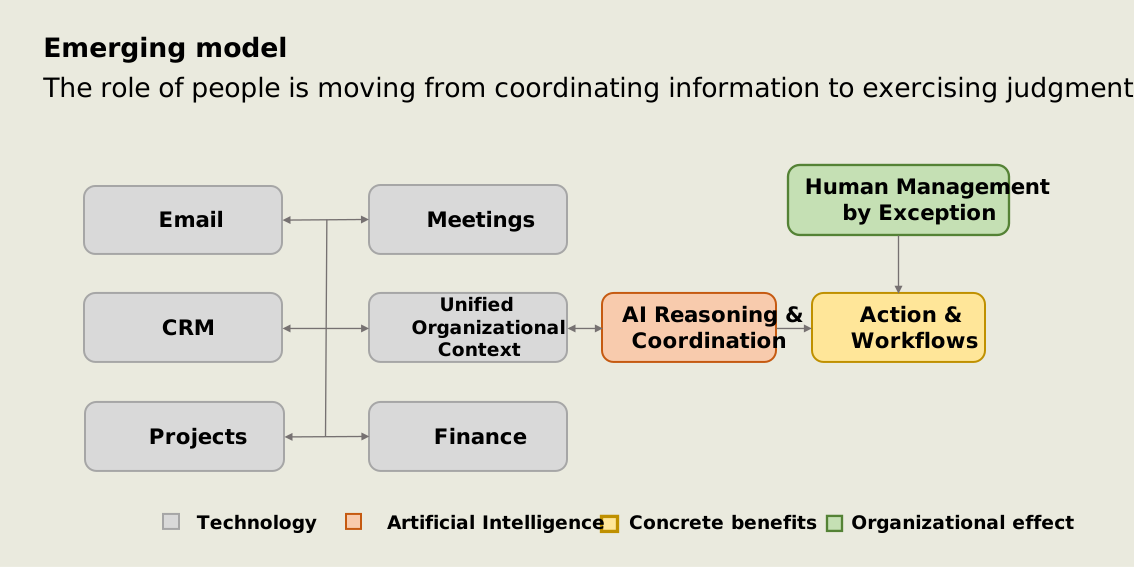
Artificial intelligence introduces a different capability: contextual interpretation.
The prerequisite: organizational legibility
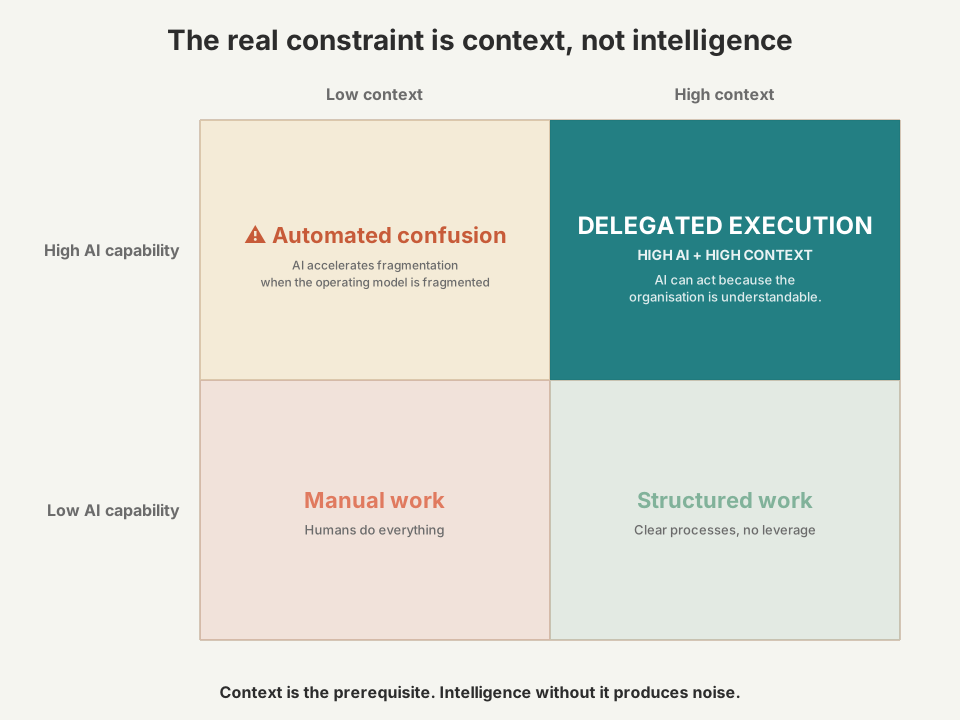
AI does not turn organizational chaos into intelligence. It inherits the operating model in which it is deployed: fragmented knowledge, unclear ownership, disconnected workflows and poorly defined decision rights will simply produce unreliable automation.The prerequisite is organizational legibility: work must be visible, ownership defined, knowledge accessible, decisions traceable and processes coherent enough to be understood.

That makes AI adoption fundamentally an organizational design question, not simply a technology one.
The real AI question
Much of the enterprise AI debate focuses on models, platforms, and capabilities. But when the operating architecture is fragmented, better AI may simply accelerate the fragmentation.
The management question therefore shifts from:
“Which AI model should we buy?”
to:
“Is our organisation structured for reliable delegation?”
That question is ultimately about strategy, governance and execution, not technology alone.
What Actually Disappears
The popular debate about AI often starts with jobs. The more immediate organizational change is likely to occur somewhere else: in the composition of work.
AI's near-term impact is less about replacing jobs than changing the composition of work. By automating repetitive coordination and information-handling tasks, it can reduce the administrative burden around people and redirect human attention toward judgement, creativity, negotiation and accountability. The goal is not fewer humans, but less machine-like work for humans.
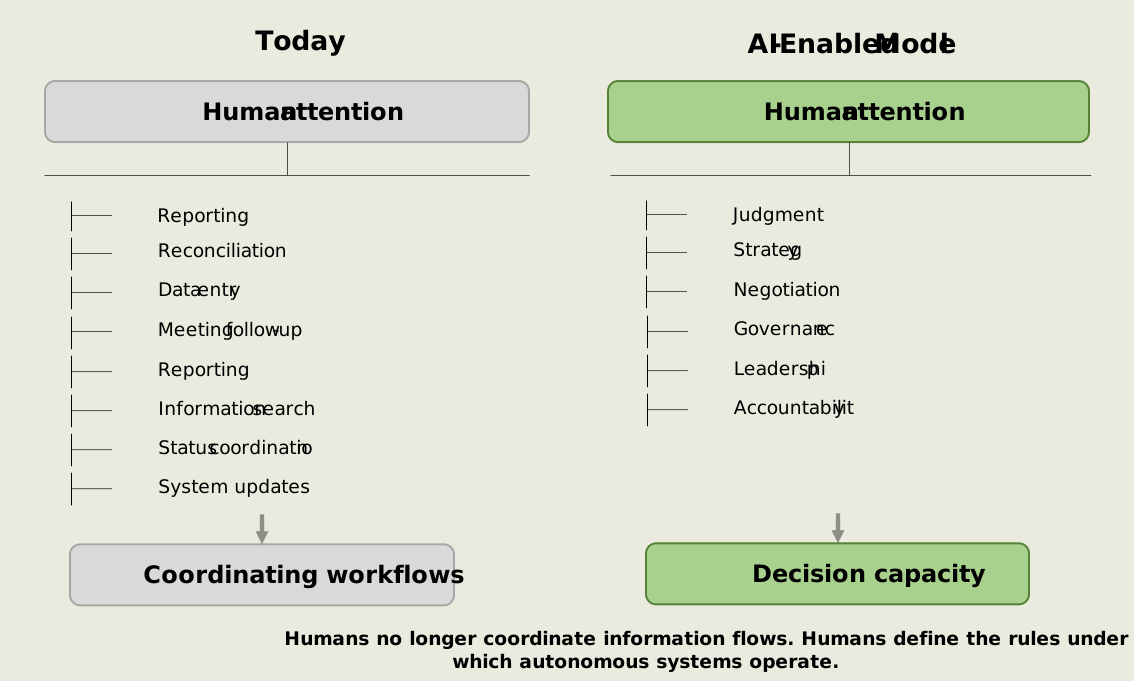
The objective is therefore not simply to reduce headcount. It is to remove the coordination burden surrounding human judgement and redeploy human capacity towards decisions, relationships, risk, and accountability.
Work Displaced, Not Eliminated
Healthcare offers a useful warning. Many medical organizations have moved towards centralized patient records, yet nurses often report spending substantial time documenting, reconciling, and entering information into those systems rather than caring directly for patients. The technology has changed the composition of the job without eliminating the underlying need for human care.
This distinction matters. Digitization does not necessarily remove work; it can simply move it. The more consequential question for AI is whether technology can remove the coordination and information-handling burden surrounding human judgement, rather than transferring that burden into a new interface.
The objective is therefore not simply fewer humans. It is less machine-like work for humans, and more time for the judgement, relationships, care and accountability that still require them.
The patient record solved an information-access problem. It did not necessarily solve the organizational work required to maintain the information.
Take-away: Technology only frees human capacity when the operating model, compliance, and regulatory environment allow it to. Otherwise, technology simply creates another layer of work.
From software stack to operating system
AI’s greatest value may begin with making organizations legible, connecting structure, context, and execution before delegating work to agents.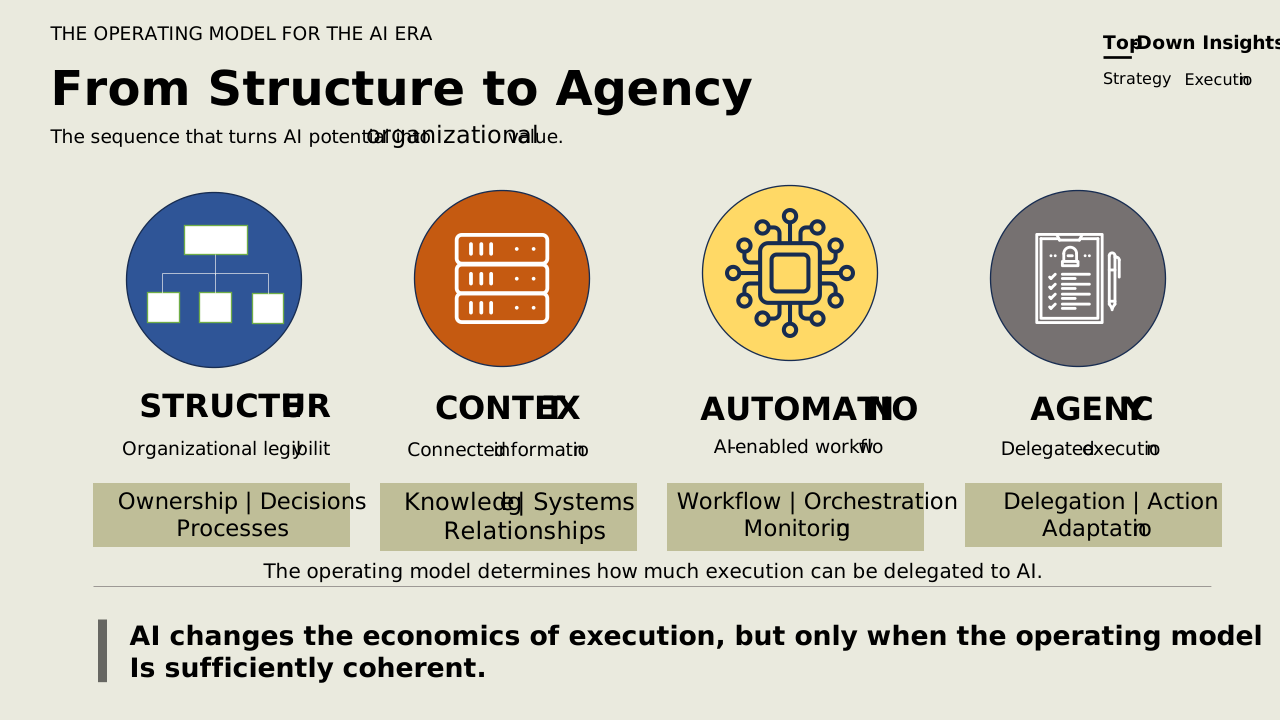
That is a much larg proposition than automation.
The future enterprise may not be a collection of software applications connected by APIs. It may be an operating system in which information, decisions, and execution are continuously connected.
The small-company advantage
There is another consequence that deserves more attention. Large organizations possess scale, resources and specialist expertise. They also possess accumulated complexity: legacy systems, process layers, reporting structures, organizational boundaries and decades of institutional habits.
Smaller companies often have less operational baggage. That may become a competitive advantage. A 50-person company can rethink information flows, decision rights and management routines far faster than a 50,000-person multinational.The advantage may therefore belong less to the organization with the biggest AI budget than to the one willing to redesign how work moves through the business.
Simply put, current architecture can outperform sophisticated architecture nobody understands. This points to a deeper shift in how organizations scale. Historically, growth meant adding coordination: more managers, reporting, functions, committees, and processes. AI creates the possibility of scaling differently: more organizational capacity, without proportionally more organizational coordination. The businesses that master this may be the next generation of high-leverage value enablers.
What remains fundamentally human
AI will not make management obsolete. It will change what senior management is paid to do.
Agents can process information, monitor workflows, generate recommendations and coordinate thousands of operational interactions. But they cannot set organizational purpose, make strategic trade-offs, accept risk, or carry accountability for the consequences.
As routine coordination is automated, the scarce resource becomes executive judgement, and the organizational clarity needed to apply it. This is where many CXOs still face the harder problem: not a lack of information, but fragmented structures, unclear decision rights, and persistent operational friction that consume executive attention.
The opportunity is therefore not simply to automate more work. It is to remove the friction that prevents leadership from focusing on the decisions that matter.
That is the real productivity opportunity for the COO, CEO and wider C-suite.
Where AI challenges the C-suite
The more consequential change may be organizational rather than technological.
For decades, the C-suite has been divided into familiar territories: the CEO sets direction, the CFO controls resources, the CIO manages technology, the COO runs operations, while other functions govern their respective domains. Boards have largely been built around these boundaries.
AI begins to challenge them at their common centre: how work actually moves through the organization.
Information, decisions, controls and execution no longer fit neatly within functional silos when connected systems and AI agents can operate across them. Activities once distributed between operations, technology, finance and management can increasingly be redesigned as a single flow.
That creates an uncomfortable question for established boardrooms: if the operating model changes, do the traditional boundaries of the C-suite still make sense?
For CEOs and CXOs, this is not primarily a technology challenge. It is an operating-model challenge, and a source of opportunity. The organizations that address it early can remove the friction, duplication, and coordination burden that have become accepted features of corporate life.
The pain was once human. Technology made it operational. AI may make it strategic and human again.
The question every CEO should ask
The default management question is still: where can we use AI? A more revealing one is: where are we still using people to connect what the organization already knows?Information copied between systems. Managers assembling reports that machines could reconcile. Knowledge trapped in meetings and inboxes. Decisions that lose momentum somewhere between approval and execution. Organizational memory that still resides in individuals.
These are not primarily technology problems. They are signs of an operating model carrying more coordination burden and legacy than it should. The competitive advantage of AI may therefore come less from automating individual tasks than from removing the organizational friction between them.
The top-down view
The public debate remains focused on models, applications and agents. For management, the more consequential question is what happens to the organization around them.
AI can increasingly connect information, support decisions, and trigger action across functions that have traditionally operated through hand-on. AI challenges a long-standing assumption: organizational complexity requires proportionally more coordination. Or it may not. The strategic chain is no longer simply technology → productivity. It is
INSIGHT
The long-term competitive advantage of AI may not be measured by how much work an organization automates, but by how much human capacity it frees from connecting work that should already be connected. That makes organizational clarity an increasingly valuable form of competitive capacity. The organizations best positioned to capture the benefits of AI will not necessarily be those with the most advanced models. They will be those that understand where complexity is creating friction, where coordination is consuming capacity, and where technology can remove rather than amplify it. The strategic task is therefore not simply to automate the organization. It is to make the organization easier to understand, easier to manage, and easier to execute; and then use AI where it creates genuine leverage.CHRISTOPHE SCHMID
Strategic COO | Transformation & Governance Advisor
I analyze structural shifts and translate them into practical management implications. Drawing on over 20 years of executive leadership experience, I help management teams identify where organizational complexity is constraining visibility, decision-making, and execution, and determine what needs to change.
My work combines organizational diagnosis, the 12 Organizational Maps™ and Rapid Clarity™ to make structural problems visible before they become execution problems.
From there, the focus is practical: redesigning operating models, governance structures, and execution systems to create greater clarity, accountability, and organizational leverage.
The objective is not more complexity.
It is a business that can see clearly, decide effectively, and execute with less friction.